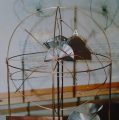
They are about transforming one line into another by rotating the space around the line as it is being drawn. If you rotate with the space you see no change in the first line, but if you do not, you see it as the second one. It is clear that the line needs to be drawn over a time period for this to be done.
The unit of space used is a three-dimensional Cartesian co-ordinate frame (ie. a cube) with its origin (its centre) the centre of a 40cm diameter sphere. It is easy to illustrate the process in two dimensions. Take two pieces of card, a pencil, a ruler, and a drawing pin. Push the pin upwards through the centre of both pieces of card, the bottom one of which should be larger than the top one, which is roughly circular in shape. Place the ruler over the smaller piece of card with its ends protruding and tape these to the larger piece. The smaller card is now free to rotate between the larger one and the ruler. Draw a line with the ruler on the smaller card while rotating it. The line is curved. Draw the same line without rotating the card: it is straight. The same line is both straight and curved depending on how the surface on which it is drawn is moving.
Now draw a wiggly line on the card while it is stationary, making sure not to draw it closer to the drawing pin than is the ruler. If the small card is rotated slowly, the line may be traced along the edge of the ruler with the pencil point. The prints and constructions depict precisely the same things, only in three dimensions. Lines have been made to trace out planes (the wriggling steel rod and the cup), but the only part of these planes visible at any given moment is a single line, like a windscreen-wiper on a windscreen. A detailed description of the method used (trigonometry – rather like miniature land surveying) is given in a booklet entitled “Rigid Eels and Wriggling Steel Rods – The Perception of Relative Motion Through Rotating Frames” (available on request). The titles of the prints refer to chapter headings, and like the booklet’s title are derived from a quotation from “The ABC of Relativity” by Bertrand Russell (George Allen & Unwin, London, 1958):
“The point is not that eels are really rigid, but that steel rods really wriggle. To an observer in just one possible state of motion the eel would appear rigid, while the steel rod would seem to wriggle, just as the eel does to us. For everybody moving differently both from the observer and ourselves, both the eel and the rod would seem to wriggle. And there is no saying that one observer is right and another wrong.”
The rotation of the frame is used as the time co-ordinate to form a model of four dimensions.
For a short exhibtion video, type David White 7A Limoges
 davidmichaelwhiteart